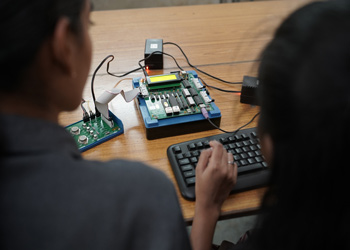
 The Department of Electronics and Communication Engineering was started in 2002. The department offers a four year B.E. Electronics and Communication Engineering Programme with sanctioned intake of 60 from 2002-2003 onwards.
The Department has increased its intake strength to 120 from 2005-2006 onwards.
The department offers M.E. Communication System with an intake of 18 from 2013-2014 onwards.
All the classrooms are smart classrooms with satellite enabled learning facilities.
The Department has 7 Doctorates and 10 of the faculty members are pursuing their research leading to Ph.D. degree.
The department also has young, dynamic and energetic faculty members. Texas Instruments sponsored labs- TI analog System Design Lab and TI Embedded System Design Lab have been set up.
MOU is signed with Roots Group & Salzer Electronics Ltd., Coimbatore, Texas Instruments, Micromax Systems Pvt. Ltd, Trichy, Sertel Electronics Pvt Ltd, Chennai, Prime SoC ,Chennai for undertaking
R&D projects. Faculty members are life members in different professional bodies like IEEE, IETE, ISTE, IETE student forum (ISF) started in the year 2010.
The department is a Recognised Research Centre under Anna University,Chennai.
The department has 3 recognised Supervisors under Anna University,Chennai and are guiding many Ph.D Scholars. Many scholars have completed their Ph.D Degree under the research centre.
The Department of Electronics and Communication Engineering was started in 2002. The department offers a four year B.E. Electronics and Communication Engineering Programme with sanctioned intake of 60 from 2002-2003 onwards.
The Department has increased its intake strength to 120 from 2005-2006 onwards.
The department offers M.E. Communication System with an intake of 18 from 2013-2014 onwards.
All the classrooms are smart classrooms with satellite enabled learning facilities.
The Department has 7 Doctorates and 10 of the faculty members are pursuing their research leading to Ph.D. degree.
The department also has young, dynamic and energetic faculty members. Texas Instruments sponsored labs- TI analog System Design Lab and TI Embedded System Design Lab have been set up.
MOU is signed with Roots Group & Salzer Electronics Ltd., Coimbatore, Texas Instruments, Micromax Systems Pvt. Ltd, Trichy, Sertel Electronics Pvt Ltd, Chennai, Prime SoC ,Chennai for undertaking
R&D projects. Faculty members are life members in different professional bodies like IEEE, IETE, ISTE, IETE student forum (ISF) started in the year 2010.
The department is a Recognised Research Centre under Anna University,Chennai.
The department has 3 recognised Supervisors under Anna University,Chennai and are guiding many Ph.D Scholars. Many scholars have completed their Ph.D Degree under the research centre. 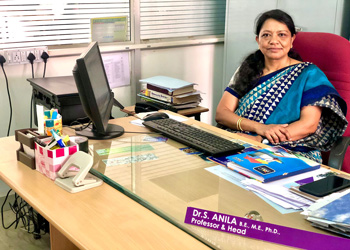 I am very happy to introduce our Electronics and Communication Engineering department as one of the prestigious departments in our college. Thanks to the efforts of our doctorates, teachers and our students, we continue to play a leading role in our discipline. The department has consistently maintained an exemplary academic record. The greatest asset of the department is its highly motivated and learned faculty.
 Electronics and Circuits Laboratory
The Electronics and Circuits Laboratory is a
well-equipped facility that provides students with hands-on training in electronic measurements, circuit design, testing, and
implementation. The laboratory is equipped with Digital Storage Oscilloscopes (DSO), Cathode Ray Oscilloscopes (CRO), function
generators, regulated power supplies, trainer kits, IC testers, and various measuring instruments. Students perform experiments
involving electronic component testing, diode characteristics, rectifier circuits, signal measurement and analysis, digital logic
circuit design, circuit simulation, soldering techniques, power supply design, and sensor-based applications using Arduino.
The laboratory enhances practical skills, troubleshooting abilities, and proficiency in modern electronic instruments,
preparing students for real-world engineering challenges and industry requirements.
Microprocessor Laboratory
Microprocessor Laboratory is equipped with 8086, 8051 and ARM Cortex Trainer kits.
A microprocessor is designed to perform arithmetic and logic operations that makes use of registers.
Typical microprocessor operations includes adding, subtracting, comparing two numbers and fetching numbers from one memory space to another.
These operations are the result of a set of instructions that are part of the microprocessor design. Stepper motor Controller, ADC, DAC, Keyboard and Display controller (8279)
can be interfaced with 8086 8051 and ARM Cortex boards for conducting interfacing based experiments.
Microsoft Assembler (MASM) is used for simulation of microprocessor and microcontroller based programs.
ECE, EEE and Mechanical Engineering students use this laboratory for their laboratory courses in their programme.
Microwave & Optical Communication Laboratory
Microwave and Optical Communication Laboratory is equipped with a wide range of well- maintained major and minor equipment to support practical learning and research in communication engineering. The major equipment includes a Klystron Bench (J-Band), Microwave Power Meter, X-Band Microwave Components, Radiation Pattern Table, Gunn Power Supply, PIN Modulator, Isolator, Variable Attenuator, Direct Reading Frequency Meter, Fiber Optic Components, Laser Diode, BCK Splicing Kit, Advanced Fiber Optic Communication Kit with BER Module, and Programming Library Software.
The Microwave Laboratory features both X-Band and J-Band bench setups, providing students with hands-on training in RF and Microwave Engineering. Laboratory is equipped with advanced optical fiber trainer kits that enable students to study numerical aperture, attenuation measurements, and analog and digital transmission characteristics. The LED and Laser Diode units facilitate the analysis of source and detector characteristics.
Spread over an area of 90 sq. m., the laboratory offers an excellent environment for conducting experiments in Microwave Engineering, Optical Communication, and Antenna Analysis. The facility plays a vital role in enhancing the practical knowledge and technical skills of Electronics and Communication Engineering (ECE) students.
Electronic System Design Laboratory
The lab is equipped with equipments such as DSO (100 MHZ), CRO (30 MHz), Function Generator (3 MHz), Single Power Supply (0-32V), Dual Power Supply (0-32V)
Digital Trainer Kit with various ranges, ARM Processors, Programmable Logic Controller Kit, Digital and Analog IC
Tester, Micro Controller Based Strain Gauge Trainer Kit, Micro Controller Based Thermocouple Trainer Kit, Micro Controller
Based LVDT Trainer Kit, Embedded Trainer Kits with ARM Board and also Embedded Trainer Kits for Wireless Communication.
The cathode ray oscilloscope is used to display and analyze various waveforms of electronic circuits.
Digital storage oscilloscope is an oscilloscope which stores and analyses the signal digitally rather than using analogue techniques.
It is now the most common type of oscilloscope in use because of the advanced trigger, storage, display and measurement features which it typically provides.
With the help of Digital and Analog IC Tester working conditions of various IC’s can be tested within a fraction of seconds. Embedded Trainer Kits can be used to
implement various embedded systems for real time applications.
Digital Signal Processing Lab/VLSI Laboratory
The Digital Signal Processing (DSP) Laboratory is equipped with advanced software and hardware facilities to support laboratory courses,
research activities, and project development in the fields of Digital Signal Processing, VLSI Design, Computer Networks, and Electronic Circuits.
The laboratory houses high-performance Intel Core i5 processor-based computers with high-speed computing capabilities for the efficient design, simulation,
analysis, and verification of engineering applications. The software resources available include MATLAB, Xilinx Design Suite, Tanner EDA, ORCAD,
L-SIM and N-SIM Protocol Simulation Software, and Mentor Graphics HEP Category-2 Design and Verification Tools. The laboratory is also equipped with
modern hardware platforms and instruments such as DSP Processor Kits, ARTIX-7 FPGA Boards, Xilinx Spartan FPGA Kits, Spectrum Analyzers,
Cathode Ray Oscilloscopes (CROs), Function Generators, and other electronic testing and measurement equipment. These facilities enable students and researchers to
gain hands-on experience in signal processing, embedded systems, FPGA-based design, VLSI implementation,
communication systems, and electronic circuit analysis, thereby fostering innovation, technical excellence, and research-oriented learning.
RF and Communication Laboratory The RF & Communication Laboratory of the Department of Electronics and Communication Engineering provides a comprehensive platform for experiential learning in Radio Frequency (RF), Microwave Integrated Circuits, Analog, and Digital Communication Systems. The laboratory is equipped with advanced instruments such as Network Analyzers, Spectrum Analyzers, Digital Storage Oscilloscopes, Frequency Counters, RF Signal Sources, Antenna Trainer Kits, and Antenna Measurement Systems, enabling students to gain practical exposure to modern communication technologies.
The laboratory supports experiments in transmission line analysis, antenna characterization, modulation and demodulation techniques, multiplexing, RF signal measurements, and wireless communication systems. A wide range of communication trainer kits covering AM, FM, PCM, Delta Modulation, ASK, FSK, PSK, QPSK, DPCM, GPS, and Frequency Synthesizer applications help students bridge theoretical concepts with real-world implementations.
The facility is further strengthened with MATLAB and Simulink-based simulation tools, enabling students to model, analyze, and validate communication systems before hardware implementation. This integration of simulation and experimentation enhances students' design, analytical, and problem-solving skills, preparing them for careers in RF engineering, wireless communications, and advanced communication system design.
